
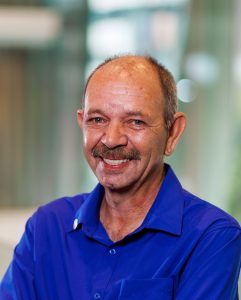
Lloyd Dolan is a Wiradjuri man from Hay NSW, and has family ties to Narrandera through the Christians and Woods families, and to Mathi Mathi through the Murray and Kirby families.
Lloyd is a member on our LIPPE Steering Committee. He has just retired from his role as Academic Lead (First Nations) at Charles Sturt University where he provided strategic leadership and direction regarding Indigenous curriculum requirements at multiple qualification levels.
APC’s Cultural Safety and Indigenous Advisor, Dr Aunty Jane Havelka, caught up with Lloyd for a yarn about his continued involvement with the LIPPE Network, the importance of Indigenous voices in governance, and how to engage with local Aboriginal and Torres Strait Islander communities.
Aunty Jane: As you step into retirement, you’re continuing your involvement with the LIPPE Steering Committee. What is it about the Network and its vision that remains important to you?
Uncle Lloyd: It’s really about the profession – ensuring that it continues to grow for mob and the next step. We now have got 137 registered (First Nations) pharmacists, but what are we actually doing to support them to go further? How are we supporting those existing ones to progress?
Aunty Jane: What has stood out to you about embedding Indigenous leadership within pharmacy?
Uncle Lloyd: That ability to listen and take on board what’s said.
But then sometimes it gets a bit frustrating in the process because anything Indigenous would be targeted to you for thoughts in that space – rather than everybody in the room. It can be very much directed to the Indigenous people in those conversations. Even though many people in the room have a lot of experience, they weren’t seen as the people to have a conversation with.
That’s where it’s interesting with pharmacy going forward. We have some great allies working in the space. But sometimes it’s not just the Indigenous voice we need to hear from – we need to hear from their voices as well.
Aunty Jane: What advice (first steps) do you have for universities looking to engage with their local Aboriginal and Torres Strait Islander communities?
Uncle Lloyd: This is one of the things that comes up, particularly with spaces like universities, because they have such large footprints – and then try to represent that with the First Nations peoples.
The communities aren’t structured that way. If your footprint covers 5 different nations, then the reality is you should actually be engaging with 5 different nations – not one person that somebody knows, which is often what happens. That’s the challenge. For example, CSU has a large footprint in many campuses, but not each campus engages with local community directly. It’s done at that institutional level, and they’re talking to bodies such as NSW Aboriginal Education Consultative Group Inc or NACCHO, which is fine, but that may not bring in the local community into what’s happening in the space.
You may want to increase Indigenous enrolments in your programs, but you may not communicate with parents, or with carers – the focus is schools and the kids at school. Now, if you’re not talking to the parents, how are they going to support and let their kid go to university? To a place they know nothing about, to work with people they don’t know?
Aunty Jane: One of the most successful programs we ran at Charles Sturt University in Wagga was an orientation initiative specifically for Aboriginal and Torres Strait Islander students and their families. We invited parents and carers to come along, sit in classes and experience the university environment alongside their children. It wasn’t just about introducing students to campus, it was about building trust and helping families understand where their young people would be studying and who would be supporting them.
Uncle Lloyd: We found that inviting the parents to come in before they made the decision to enrol was better and more beneficial because we sat down with them and we did the, “who is your mob, where are you from?” and they went, “you know, you’re the first university we’ve contacted that’s actually asked us those sort of questions.”
It’s been more about, ‘here’s your enrolment, here’s your course’ – no connection. And so those students are then supported from the family side of it as well. This university is actually taking not just the students but their families to their universities.
When families felt connected to the university, students felt supported to stay. Many went on to graduate and later returned as mentors. Real engagement starts with relationships.
Aunty Jane: Over your time with LIPPE, what have you learnt about the importance of governance and leadership in creating meaningful and lasting change?
Uncle Lloyd: You can’t jump straight into the endpoint. It’s a process and (LIPPE) has taken a while. You can’t jump straight into a strategy and not have recruited Indigenous membership for your Board, for your Committees, for anything like that. How do you expect to jump straight to a strategy when you haven’t got the groundwork?
I’m now on the Board of Directors for Work-Integrated Learning Australia. I’m working with them on their election process, and we’ve amended their constitution to have an Indigenous Director position filled by an Indigenous person. Their November elections will be the first time we have an Indigenous Director appointed to the Board to lead that process forward. We need to start there.
We would like to advise Aboriginal and Torres Straight Islander peoples that this website contains images, voices or names of a person who has died.