
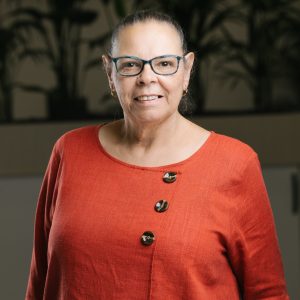
Aunty Jane reflects on how finding belonging and cultural safety at university helped transform self-doubt into confidence.
In 1997, I was working at Wagga Wagga Base Hospital as the first Aboriginal Hospital Liaison Officer.
As part of my role, I was given the opportunity to study a Diploma of Health Science (Aboriginal Health and Community Development) at the University of Sydney.
To be honest, I was terrified.
I had never imagined myself at university.
Like many Aboriginal people of my generation, I had grown up hearing messages about what we couldn’t do rather than what we could.
I doubted myself.
I remember thinking that everyone else would be smarter than me.
The journey to Sydney felt like a journey into an unfamiliar world.
When I arrived, I discovered something I hadn’t expected.
Every student in my class was a First Nations person.
Many of the lecturers were First Nations people too.
That changed everything.
For the first time, I was learning in a space where I didn’t feel different.
The stories, experiences and challenges being discussed were familiar to many of us.
The learning environment felt safe.
As my confidence grew, I began to realise that the problem had never been that I didn’t have a brain.
The problem was that I had spent years questioning whether I belonged in places that were not designed with people like me in mind.
That experience taught me something I have carried throughout my career.
Success is not only about academic ability.
People learn best when they feel safe, respected and supported.
When people feel they belong, they begin to see possibilities that they may never have imagined for themselves.
Looking back now, I realise that my first day at university was about much more than starting a course.
It was the day I started believing that I had something valuable to contribute.
💭 Pause and Reflect
Aunty Jane shares how a First Nations orientation program demonstrated the powerful role belonging plays in student success.
Years after my own first day at university, I found myself working with First Nations students who were beginning their own journeys.As I listened to their experiences, I recognised something familiar.
Many were carrying the same fears and uncertainties I had once carried.
Some were leaving family, community and Country for the first time.
Some were the first person in their family to attend university.
Some wondered whether they belonged.
I remembered standing in those shoes myself.
That is why, when we noticed First Nations students were leaving orientation feeling disconnected, we knew we needed to do something different.
We realised that before students could learn about university systems, they needed to know they belonged.
So, we created a separate First Nations orientation.
Families were invited.
Students met Elders and support staff.
They learned how university worked, but they also learned who they could turn to when things became difficult.
The information was the same.
The difference was safety.
That experience taught me that treating everyone the same does not always create equity.
Sometimes people need something different in order to have the same opportunity to succeed.
💭 Pause and Reflect
A reflection on representation, inclusion and the importance of involving First Nations peoples from the very beginning of decision-making.
Sometimes when I attend meetings, I find myself asking a simple question:Who is missing?
The people in the room are often knowledgeable, committed and well-intentioned.
Yet there are times when a decision is being discussed that will affect First Nations people and no First Nations people are present.
Sometimes consultation is planned after decisions have already been developed. Sometimes communities are asked to comment on solutions they were never involved in designing.
When this happens, engagement can become a process of informing rather than listening.
I have learned that inclusion is not about inviting people to comment at the end.
It is about involving people from the beginning.
The most culturally safe outcomes I have seen are those where First Nations people helped shape the conversation before decisions were made.
💭 Pause and Reflect
Aunty Jane explores the challenge of navigating professional expectations while remaining connected to culture, community and identity.
Many First Nations students and professionals learn to navigate two worlds.
One world is built on culture, family, community and Country.
The other is built on organisational systems, policies and professional expectations.
People often speak about this as though it is easy.
It is not.
Sometimes people feel pressure to leave part of themselves behind in order to fit into a workplace or institution.
Sometimes they feel responsible for representing all First Nations people. Sometimes they are expected to educate others while also doing their own work.
What I have learned is that cultural safety exists when people do not have to choose between professional success and cultural identity.
People do their best work when they can bring their whole selves into a space.
💭 Pause and Reflect
A simple question taught Aunty Jane the value of curiosity, understanding and listening before making assumptions.
Early in my career, I often heard professionals ask: “Why don’t people engage?”
Over time, I began asking a different question: “What happened to make engagement difficult?”
Those two questions lead in very different directions.
The first can place responsibility on the individual.
The second invites us to understand experiences, relationships, history and trust.
When we ask what happened, we begin to understand that people’s responses are often shaped by previous encounters with systems and institutions.
Suddenly the conversation becomes less about compliance and more about relationships.
That shift changed how I worked with people and communities.
💭 Pause and Reflect
A reflection on the lessons that can emerge when we slow down, listen deeply and make space for others.
Some of the most important things I have learned were never said directly to me.
They were learned through watching.
Through listening.
Through sitting quietly and paying attention.
When I was younger, I used to wonder why some Elders took their time before answering a question.
In school, we were often taught that when a question is asked, you answer it as quickly as possible.
Silence could feel uncomfortable.
Sometimes people assumed that silence meant nobody knew the answer. What I came to understand was that silence can have a different meaning.
Sometimes silence is a sign of respect. Sometimes it is a sign that people are thinking carefully about what should be said. Sometimes it is a way of making space for others.
And sometimes the most respectful response is to listen rather than speak.
Over the years, I noticed that some of the strongest relationships were built by people who knew how to listen.
Not listening while waiting for their turn to talk. Not listening so they could argue a different point of view.
Just listening.
Many of us live in a world that moves quickly.
Meetings have agendas. Conversations have time limits. People often feel pressure to fill every silence.
Yet some of the most meaningful conversations I have had happened after a period of silence.
The silence gave people time to think. Time to reflect. Time to decide what they wanted to share.
As a counsellor, I learned that silence is not something to be feared.
As a student, I learned that silence can be a teacher.
As a cultural advisor, I have learned that listening is often more important than speaking.
Learning through silence taught me that knowledge is not always found in the loudest voice in the room.
Sometimes it is found in the space we create for others to be heard.
💭 Pause and Reflect
Aunty Jane explores why cultural safety is shaped by impact rather than intention.
Early in my career, I believed that if people had good intentions, things would usually work out.
Surely that was enough.
Then I started working more closely with individuals, families and communities.
What I noticed was that some people were leaving services feeling unheard, frustrated or unsafe, even when staff genuinely wanted to help.
At first, this didn’t make sense to me.
Over time, I realised that good intentions and good outcomes are not always the same thing.
A person can mean well and still make assumptions.
A person can want to help and still fail to listen.
An organisation can have positive intentions and still create barriers that stop people feeling safe or included.
I began thinking about this in my own life.
There have been times when people have said something they believed was helpful, but it left me feeling misunderstood.
There have been times when decisions were made for Aboriginal people rather than with Aboriginal people.
The intention may have been positive.
The impact was not.
That was the day I realised that cultural safety is not measured by what we intended to do.
It is measured by how our actions are experienced by others.
This understanding changed the way I worked.
I became less focused on proving that I meant well and more focused on listening.
Less focused on having the answer and more focused on understanding the question.
Less focused on defending actions and more focused on learning from feedback.
Good intentions matter.
They are often where the journey begins.
But they are not where the journey ends.
Real cultural safety requires us to be curious, reflective and open to hearing when our actions have caused harm, even when harm was never intended.
💭 Pause and Reflect
This yarn reflects on the connection between Country, culture, community and wellbeing.
When I first started working in health, I learned a lot about the human body.
These things were important.
But over time, I realised there was something missing.
The more time I spent listening to First Nations people and communities, the more I understood that health was about much more than what was happening inside a person’s body.
Country helped teach me that.
For many First Nations people, Country is not simply a place on a map.
Country holds stories, responsibilities and relationships that stretch across generations.
When people are disconnected from Country, they are often disconnected from far more than land.
They may be disconnected from community.
From a sense of who they are and where they belong.
As a counsellor, I met people carrying grief, loss and trauma.
Often these experiences could not be understood by looking only at the individual.
The story was bigger than that.
It involved family.
What Country taught me is that health is about relationships.
It is about our relationships with ourselves, with others, with culture, with community and with the places that give our lives meaning.
When those relationships are strong, people often find strength, resilience and healing.
When those relationships are damaged or broken, the impacts can be felt in many different ways.
This changed the way I thought about healthcare.
Instead of asking only:
“What is wrong with this person?”
I began asking:
Country taught me that health is not just the absence of illness. Health is connection.
When we understand this, we begin to see health through a much wider lens.
💭 Pause and Reflect
Aunty Jane shares how everyday experiences shaped her understanding of racism and its lasting impacts.
When I was growing up, we didn’t spend much time talking about racism.
As kids, we didn’t see black and white.
We saw people we played with, laughed with and went to school with.
For the most part, we simply saw ourselves as fitting in.
As children, we often accept people for who they are.
We don’t arrive in the world carrying prejudice.
We learn attitudes from the environments around us.
As I got older, I began to notice things that I had not recognised when I was younger.
At the time, many of these experiences were not called racism.
In fact, people rarely used that word.
Often, the behaviour was explained away.
People would say:
Looking back now, I can see that racism is not always loud.
It is not always someone openly declaring that they dislike another group of people.
One of the challenges is that if we never name racism, it becomes difficult to address it.
People can experience harm while those around them insist that no harm was intended.
Over the years, I learned that cultural safety is not about blaming people.
It is about creating spaces where we can honestly examine our assumptions, learn from one another and recognise when systems or behaviours may be causing harm.
The goal is not guilt.
The goal is understanding.
When we understand how racism operates, even in subtle ways, we are better able to create places where everyone feels respected, valued and safe.
💭 Pause and Reflect
A reflection on the diversity of First Nations experiences and the limitations of expecting one voice to represent many.
Throughout my career, people have often asked me questions that made me uncomfortable.
Not because they were trying to be offensive.
But because they assumed I could speak on behalf of all Aboriginal people.
One question I used to be asked when I was nursing was:
“How many Aboriginal nurses are there?”
I never knew.
And even if I did, I was never quite sure why people thought I would have the answer.
Another question I am still asked today is:
“What do you think about…?”
Usually it is whatever issue is in the news that week.
A government announcement.
A public debate.
A media story.
An organisational decision.
What has always puzzled me is the assumption that I must have an opinion on every issue simply because I am Aboriginal.
And if I do have an opinion, why am I expected to share it?
I don’t ask every non-Indigenous person what they think about every issue affecting non-Indigenous Australians.
Yet First Nations people are often expected to explain, defend or comment on matters that are much bigger than themselves.
The reality is that no one person can speak for all Aboriginal and Torres Strait Islander peoples.
We come from:
Like any group of people, we do not all think the same way.
Over time I learned that there is a difference between asking someone for their perspective and asking them to represent an entire population.
One invites a conversation.
The other places a burden on the individual.
Cultural safety is not about finding one Aboriginal person and asking them to speak for everybody else.
It is about recognising the diversity of First Nations voices and creating opportunities for many voices to be heard.
The most respectful question is often not:
“What do Aboriginal people think?”
But rather:
“What is your experience?”
💭 Pause and Reflect
Aunty Jane explores the challenges and responsibilities that can come with being the sole First Nations voice in a space.
There have been many times in my career when I have been the only First Nations person in the room.
Sometimes people become more careful when they realise this.
Other times they become more comfortable saying things they would not normally say because they assume nobody will challenge them.
I have sat through meetings where Aboriginal people were discussed without a single Aboriginal voice present.
I have heard decisions being made about communities by people who had never visited those communities.
I have listened to conversations where culture was treated as an “extra” rather than something central to people’s lives and wellbeing.
Being the only person in the room comes with a responsibility. Sometimes you speak up.
Sometimes you choose your moment. Sometimes you leave the meeting wondering whether it was your role to educate others.
Over time I learned that cultural safety is not created because a First Nations person is present.
Cultural safety is created when everyone accepts responsibility for listening, learning and challenging assumptions.
One person cannot carry that responsibility alone.
💭 Pause and Reflect
A story about the power of welcome, respect and creating a genuine sense of belonging.
When I was growing up, my mother taught us a simple rule.
Whenever we went to someone’s house, we waited behind her until we were welcomed inside.
As children, we didn’t always understand why.
We would stand at the door waiting while Mum spoke with the person inside.
To us, it seemed unnecessary.
After all, in our neighbourhood it wasn’t unusual for kids to walk straight into each other’s houses.
We would sit down, grab a drink, find something to eat and make ourselves at home.
One day I asked Mum why this was okay if we were supposed to wait to be welcomed.
She explained that those homes were different.
At some point, we had already been welcomed.
The invitation had already been given.
The relationship had already been established.
Because of that relationship, we knew we could enter and we knew we belonged.
Mum told us this was the way of our people.
You don’t simply enter someone else’s space.
You respect that it belongs to them.
You wait to be welcomed.
Only then do you enter.
As I got older, I realised this lesson was about much more than houses.
Today, when I hear people talk about Welcome to Country and Acknowledgement of Country,
I often think about those lessons from my mother.
A Welcome is not simply a formality.
It is an invitation.
It is an act of generosity.
It is someone saying, “You are welcome here.”
For many First Nations people, Welcome has always been connected to relationship, responsibility and respect.
When we understand this, Welcome becomes more than words spoken at the beginning of an event.
It becomes a reminder of how we might engage with one another every day.
💭 Pause and Reflect
Aunty Jane reflects on grief, healing and the importance of understanding Sorry Business beyond fixed expectations of time.
I was 19 years old when my mother passed away.
When someone dies, people often gather around you.
Family comes together.
Friends visit.
People bring food.
People offer support.
For a little while, you are surrounded by others.
Then, eventually, people go home.
Life moves on.
For my family, that was when the hardest part began.
We were left trying to work out how to keep going without Mum.
Money was scarce.
There were bills to pay and mouths to feed.
Grief did not stop those responsibilities.
At the time, I was working in the cotton fields to help my family meet living expenses.
Some days I would be working while carrying the weight of loss that felt impossible to explain.
People often think grief follows a timeline.
They expect that after a certain amount of time a person will recover, move forward, or return to normal.
That was not my experience.
The loss of my mother did not end after the funeral.
It remained present through birthdays, family gatherings, milestones and ordinary days.
Even now, all these years later, there are moments when I wish I could pick up the phone and talk to her.
What I learned is that grief is not always something people get over.
Sometimes it becomes something they learn to carry.
This is one of the reasons I think differently about Sorry Business.
Sorry Business is not simply about the days surrounding a funeral.
It is about relationships, loss, responsibility, connection and the ongoing impact that grief can have on individuals, families and communities.
When we expect people to fit grief into a timeframe, we risk misunderstanding their experiences.
What many people need is not a deadline for healing.
What they need is understanding.
💭 Pause and Reflect
We would like to advise Aboriginal and Torres Straight Islander peoples that this website contains images, voices or names of a person who has died.